
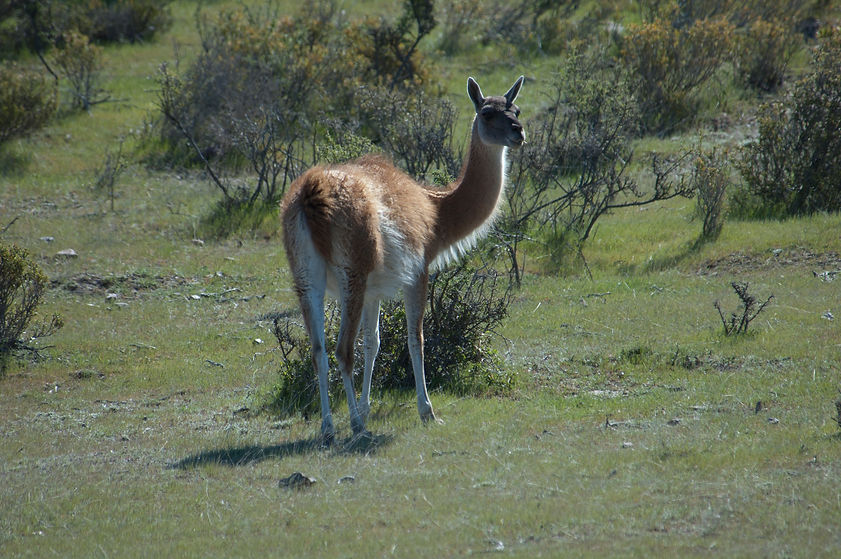
This fiber is superfine... and wild!
The guanaco (Lama guanicoe) is the dominant wild herbivore of southern South America. More than 90% of its population is found in Argentine Patagonia. Historically, its main threats have been poaching and high livestock density, which excluded it from many areas due to competition for food and space. For almost two decades, Wildlife Conservation Society (WCS), in collaboration with the National Scientific and Technical Research Council of Argentina (CONICET), have researched biological and economic aspects of live-shearing of guanacos, helping to develop methodologies that ensure the adequate animal welfare of the sheared individuals and shearing sustainability.


Guanaco Fiber
Characterized by its silkiness, lightness, and excellent insulating properties.
MICRONS
Varies from 14.5 to 17.8 µm, with a coefficient of variation (CV) of 10%. This fineness places it among the “superfine fibers.”
FIBER LENGTH
3 to 4.5 cm, with a comfort factor up to 94.5% and a grease content of 1.6%.
COLOR
Varies from reddi sh brown to light brown, and to a lesser extent, white.
SEASONS
Shearing: October
Stockpiling: November
Available from November
Guanaco fiber is suitable for both hand and industrial spinning, with the possibility of developing blends with other natural fibers.
Patagonian Producers
The possibility of developing a sustainable use program for wild guanaco presents a great opportunity for the people of the Patagonian steppe and also for conserving this native species environment.
Producers have seen the guanaco as a threat for many years , considering it to be in competition for the forage resource. Small-scale, family run livestock production sites, as well as large ranches, coexist with healthy or recovering guanaco populations throughout Patagonia. The sustainable use of the guanaco through live-shearing can represent a great opportunity to improve the quality of life of producers , to achieve coexistence between wildlife and livestock production, and for the conservation and regeneration of the whole Patagonian steppe ecosystem.


Patagonian Landscapes
Meseta de Somuncura Natural Reserve, Río Negro and Chubut
The Somuncura Plateau is a large basaltic plain located between the center-south of Río Negro Province and the center-north of Chubut Province. The status of Protected Area is intended to conserve parts of the territory that have been recognized by the scientific community, the public, and the authorities as a heritage site, where the conservation of nature is the main objective.
La Payunia Natural Reserve, Mendoza
This 664,000 hectare protected area is home to one of the largest, best protected, and least disturbed wild guanaco populations in Patagonia. The extreme aridity and topography of the region have limited human settlement and livestock raising over a large part of its surface. This low human impact may have allowed the Payunia guanaco population to maintain seasonal migration, a unique behavior in nature.

Patagonian Landscapes
Chubut Province
Various private ranches in this province are committed to developing sustainable livestock production in harmony with native wildlife, promoting coexistence and the regeneration of the soil and vegetation. The sustainable use of wild guanaco fiber is a great opportunity for the development of local economies in this area.
Santa Cruz Province
In an area of about 70,000 hectares on the west bank of the Santa Cruz River, producers who seek to coexist with guanacos raise their livestock and are convinced that the presence of this camelid also represents a productive and economic opportunity.


Ancestral Migrations, New Opportunities
It is estimated that the guanaco population has decreased from more than 30 million individuals to a little more than 2 million in the last 200 years. It is now believed that 90% of its original population has disappeared and is present in only 40% of its former range. Although the species is showing signs of recovery in some areas of Patagonia, in many others there has been a sharp decline, which affects the dynamics of the entire ecosystem. In areas of Patagonia where shearing techniques that emphasize animal welfare are employed, populations have remained healthy. In this way, live-shearing of wild guanacos could work as a complementary activity to livestock ranching and contribute to conserving wild guanaco populations.
Allies for Regeneration and Coexistence
There is a great opportunity for guanaco fiber in the luxury textile market. Its sustainable use can result in greater protection of the species as well as in conservation of the Patagonian steppe.
Live shearing can promote coexistence, increasing tolerance of ranchers towards guanacos.
Guanaco fiber is a renewable resource, 100% biodegradable, from a native and wild species. Its carbon footprint is very low: production requires low energy costs and low use of fossil fuels.
It diversifies and increases sustainability of localeconomies under progressively drier and more variable weather conditions.
Having evolved with the environment in which it lives, this wild camelid is better adapted to environmental
conditions than domestic livestock. This factor is of utmost importance due to long-term forecasts regarding
global warming and landscape desertification.